Price Comparison for Decimal vs American Odds MLB
 Available in US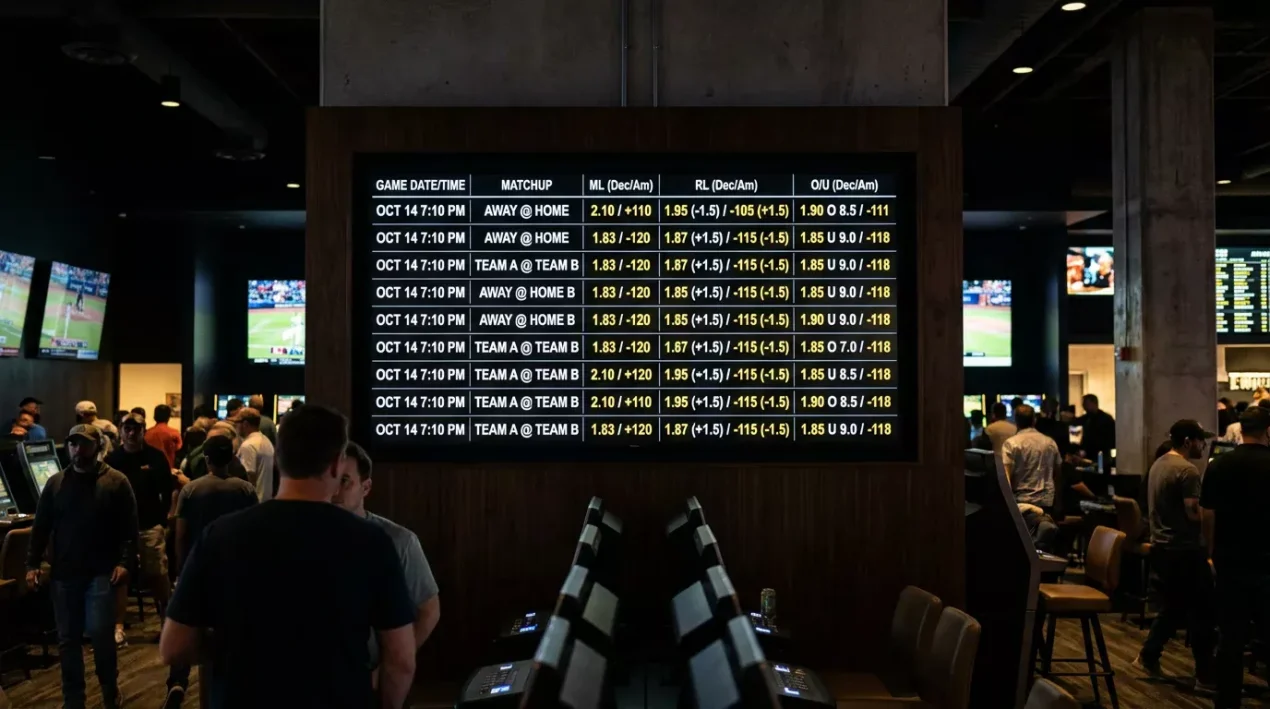
The good news is that decimal and American odds are simply two ways of saying the same thing. The information content is identical. The format you prefer is partly cultural – UK and European bettors grew up with decimal, American bettors grew up with the plus-minus system – and partly about what kind of mental maths you find easier when you are scanning a slate at speed.
Total Return Calculations with Decimal Odds
Decimal odds tell you what your stake becomes if the bet wins. That is the entire mechanic. A bet at 1.83 returns 1.83 times your stake when it lands. Bet ten quid, get eighteen pounds thirty back, of which eight thirty is profit and ten quid is the original stake returned.
The reason decimal is so popular in the UK and most of Europe is that the price you see is the price you can multiply by. There is no separate calculation. If you bet a tenner at 2.50, the slip shows you twenty-five quid as total return. If you bet a tenner at 3.20, the slip shows thirty-two pounds. You can see the payout without doing any maths in your head.
The implied probability is also clean to derive. Divide one by the decimal price. A price of 2.00 means a 50 per cent implied probability. A price of 4.00 means 25 per cent. A price of 1.25 means 80 per cent. The book has built in margin on top of these implied probabilities – usually around 4.5 per cent across a standard MLB moneyline – but the raw arithmetic is one division.
Decimal also handles fractional outcomes cleanly. A price of 1.625 means exactly that – you get 1.625 times your stake back. American odds force everything into a base-100 frame, which is fine for round numbers but gets clunky when prices land between standard increments. Decimal is just simpler when you are dealing with the granular pricing that modern MLB markets produce.
How American Odds Express Profit Relative to 100
American odds work in two halves, and the dividing line is the price at which a bet returns even money – decimal 2.00.
Anything shorter than decimal 2.00 – meaning the favourite – is expressed as a minus number. -150 means you have to risk 150 to win 100. The minus sign tells you the bet is the favourite; the number tells you the stake required to win one hundred units of profit. Bet 150 quid at -150, win and you collect 100 quid in profit plus your 150 stake back – total return 250.
Anything longer than decimal 2.00 – meaning the underdog – is expressed as a plus number. +130 means a bet of 100 wins 130. Bet a hundred quid at +130, win and you collect 130 in profit plus your 100 stake back – total return 230.
The format has one genuine advantage over decimal: it expresses the underlying risk-reward symmetry directly. When you see -150 versus +130 on a single MLB game, you can instantly tell the favourite needs to risk more than the underdog wins. The shape of the price tells you something about the market structure without requiring division. Decimal hides that structure inside the raw multiplier.
The disadvantage is that American odds are unhelpful for parlay maths and for fractional pricing. Multiplying two minus numbers in your head to work out a same-game multi is harder than multiplying two decimal numbers. American odds are designed for single-bet quick reads. Decimal odds are designed for combinations and conversions.
Side by Side: Reading the Same Price Two Ways
Take a typical MLB matchup: home team favourite, away team underdog.
In American odds: home -150, away +130. The home team needs 150 risked to win 100. The away team wins 130 on a 100 stake. The implied probability of the favourite is 60 per cent. The implied probability of the underdog is 43.5 per cent. Add them together: 103.5 per cent. The 3.5 per cent overage is the book’s margin on this market.
In decimal odds: home 1.67, away 2.30. The home team returns 1.67 times your stake. The away team returns 2.30 times. Implied probability is 1/1.67 = 60 per cent for the favourite, 1/2.30 = 43.5 per cent for the underdog. Total: 103.5 per cent. Same margin, same price, different display.
The values are identical. The cognitive load is different. If you are converting on the fly between -150 and 1.67 every time you scan a price, that is friction you do not need. The friction adds up across a slate of fifteen games when you are trying to identify the value spots fast. UK punters who train themselves to think in decimal scan slates faster, and that speed compounds across a season.
The conversion formula matters when you cross over to American-focused content – podcasts, US-based stat services, prop analysis – that quote in American. The shortcut: for plus odds, divide by 100 and add 1 to get decimal (+130 = 1.30 + 1 = 2.30). For minus odds, divide 100 by the absolute value and add 1 (-150 = 100/150 + 1 = 1.67). For more on the conversion process and shortcut techniques, the article on converting American odds to decimal walks through the formulas and common MLB prices.
Where Format Choice Actually Changes Behaviour
The format you use to scan prices changes your behaviour in subtle ways that compound across many bets.
Decimal makes parlay maths intuitive. A three-leg parlay with prices 1.50, 1.80 and 2.10 multiplies to 5.67. You can do that in your head if you are practised. The same parlay in American is -200, -125, +110 – try multiplying those in your head and most people give up. Books that default to decimal in the UK do you a favour by making it easier to see what combined bets actually pay.
American odds make small-price scanning easier. The difference between -110 and -120 is intuitive in American – you have to risk an extra ten quid to win the same amount. In decimal that is 1.91 versus 1.83, and the gap is harder to feel without doing maths. For pitcher props and totals priced in the -110 to -130 band, American tells you the structure of the price more directly.
The honest assessment is that no format is more accurate. They encode the same information. But they reward different scanning habits. UK punters who flip between podcasts in American and operator slates in decimal pay a small attention tax every time they switch. The bettors who settle on one format and stick with it scan faster and make cleaner decisions. The default at every UK-licensed operator is decimal, and that default should usually be your default too.
Odds Format Questions
The two questions UK punters ask most about format choice are about why the UK defaults to decimal and whether one format is more precise than the other. The answers come down to history, mental load, and how the same price can feel different depending on how it is displayed.
Why do most UK sportsbooks default to decimal odds for MLB?
Because UK and European punters have used decimal odds for decades across all sports, and the format integrates cleanly with parlay calculations, fractional prices and implied probability. The American minus-plus system is rare outside North American sportsbooks and would create friction for UK customers who already scan football, racing and tennis in decimal. Defaulting to decimal on MLB keeps the cross-sport scanning consistent.
Is one format more accurate than the other for MLB?
No. Decimal, American and fractional odds all encode the same underlying price. The 1.83 you see on a UK slip is identical to -120 on an American book – same implied probability, same payout structure, same margin. The accuracy is in the price itself, not in the way it is displayed. What differs is how easy each format makes specific calculations: decimal is easier for parlays, American is easier for scanning small-price differences.
This material was created by the Mound & Margin team.
Related posts
Unit Sizing & MLB Bankroll Management UK

Algorithmic Projections & MLB Handicapping Models UK