MLB Markets & Baseball Betting UK
 Available in US
A UK-native explainer for baseball's betting markets — without the American gloss.

The first time a colleague at a pub in Bermondsey asked me how baseball betting worked, I tried explaining the run line and watched his eyes glaze over within fifteen seconds. He had been backing Premier League accumulators for years. He knew Asian handicaps. He understood draw-no-bet. But the moment I said "the spread is always 1.5", he asked what the other options were — because for him, a spread market that never moves felt like a printing error. It is not. It is the most peculiar and revealing thing about baseball betting, and once you understand why it sits there permanently, half the sport's market structure falls into place.
I have spent the last six years pricing MLB markets, building models for pitcher matchups, and watching how UK-licensed sportsbooks translate American conventions into decimal odds that a punter in Glasgow can actually use. Almost every guide in English assumes you live in New Jersey and read American odds as a first language. You do not. You read 1.83 before −120, and you want to know whether your accumulator slip in London is going to behave the same way as a parlay in Las Vegas. It usually does not, and the differences matter.
This guide is built for the British reader. We will move through the moneyline, run line, totals, props, parlays and futures in decimal odds first, with American odds shown alongside for translation. We will cover the listed-pitcher rule that voids more UK bets than any other quirk in the sport, the maths behind the price, the integrity rules that reshaped MLB micro-markets in late 2025, and the tax position of a UK punter — which is not the same conversation an American bettor has. Major League Baseball pulled in 71.4 million spectators across its 2025 regular season, the third consecutive year of growth and the first such streak since 2007. The audience on this side of the Atlantic is no longer rounding error.
Compare MLB Markets & Odds for UK Punters
- The moneyline asks who wins, the run line sets a fixed 1.5-run spread, and totals price the combined runs scored. These three markets cover the overwhelming majority of MLB betting volume.
- Roughly 28 to 30 per cent of MLB games end with a one-run margin — the structural reason the run line never moves off 1.5.
- At standard −110 pricing (decimal 1.91), you must win 52.4 per cent of bets to break even. Vig sits around 4.5 per cent on most markets; props and parlays carry materially higher margins.
- UK punters pay no tax on winnings; the operator pays GBD, which delivered £188 million in Q1 of 2025/26 alone.
- The listed-pitcher rule voids more UK MLB bets than any other quirk in the sport.
In This Guide
- Baseball Betting in the UK
- Decimal, Fractional and American Odds
- The Moneyline
- The Run Line
- Totals: Over/Under
- Props, Parlays and Same-Game Multis
- Futures: World Series and Awards
- The Listed Pitcher Rule
- The Maths Behind the Price
- Integrity and Recent MLB Scandals
- Responsible Gambling
- Pre-Bet Checklist
- Frequently Asked Questions
Baseball Betting in the UK Looks Different to the American Version, and Here Is Why
Here is a question I get from new readers more than any other: if MLB is an American product and most of the regulatory drama around sports betting plays out in the United States, why does it matter that I am sitting in Manchester? The answer is that almost everything between you and the result of a baseball game is different — the odds format on your screen, the tax bill nobody hands you, the licensing body that signed off on your account, the operator's settlement rules when a starter pulls out at 4pm Eastern. None of it is cosmetic.

The UK gambling industry posted £16.8 billion in gross gambling yield in the financial year to March 2025, up 7.3 per cent, and the remote casino, betting and bingo sector — where most online MLB bets sit — accounted for £7.8 billion of that, up 13.1 per cent. Jason Davies at the Gambling Commission put it plainly: the rise has been largely driven by online gambling. That tells you what kind of market you are operating in — an established, regulated, mostly digital environment with the consumer protections, KYC and dispute routes that implies.
The UK market, in one paragraph
A UK-licensed sportsbook quotes you in decimal odds by default. You pay no tax on your winnings — the operator pays General Betting Duty and Remote Gaming Duty into the Treasury before your stake is settled. The UK Gambling Commission supervises your account, your data, your deposit limits and the operator's advertising. Major League Baseball is a foreign league, but the moment a UK-licensed book offers it, every consumer-protection rule that covers your Premier League slip covers your MLB slip too.
Then there is the cultural anchor. The London Series, MLB's flagship European event, drew roughly 110,000 spectators across the 2023 Cubs–Cardinals weekend at London Stadium, with subsequent editions averaging around 55,000 per game. The 2026 fixture was cancelled because of a clash with London Stadium scheduling and Fox's commitments to the FIFA World Cup — the first absence since the inaugural 2019 series. The London Series has been the gateway event for casual UK fans and the moment operators time pop-up markets around. Its absence in 2026 is a structural gap.
Most "how to bet on baseball" guides on the internet were written for American readers and have not been updated since US states legalised sports betting in 2018. If a guide quotes you a price as +130 without showing 2.30 alongside it, assume the writer never thought about you. This one will not make that mistake.
The other thing to hold in mind is that MLB itself is changing fast. Average regular-season game time fell to 2 hours 38 minutes in 2025, the third consecutive year below 2:40 after three decades of bloated pacing. Shorter games change how live bets behave, how often markets re-open, and how much volatility sits in the bullpen end of the night. Most American guides written before 2023 are still describing a sport that no longer exists.
Decimal, Fractional and American Odds, Side by Side
The most embarrassing mistake I ever made on a baseball slip was confusing −110 with 1.10. I was twenty-three, half-watching a game on a borrowed laptop, and I thought I was getting nearly even money on a heavy favourite. I was not. The price translates to 1.91 in decimal. What looked like a value bet was a sportsbook holding court at the standard juice.
The UK default is decimal. A decimal price of 1.91 means that for every £1 you stake, you get £1.91 back if your bet wins — that includes your £1 stake plus 91p of profit. Decimal odds are total return. They are easy to multiply across parlays, easy to translate into implied probability, and the smaller the number, the bigger the favourite.
Fractional odds, the form that haunts your father's Coral slip, express profit relative to stake. A fractional 10/11 is the same as decimal 1.91 — bet 11, win 10 in profit, get 21 total back. Mechanically identical, historically British, but most UK sportsbooks now offer a one-click toggle between decimal and fractional, and decimal has won the MLB argument because the numbers are tidier.
American odds are where it gets thorny. A minus price like −110 means you stake 110 units to win 100. A plus price like +130 means you stake 100 units to win 130. There is no built-in stake-inclusion, and the format flips between minus and plus at the break-even line.
The same price in three languages
American −110 = Fractional 10/11 = Decimal 1.91. Implied probability 52.4 per cent.
American +130 = Fractional 13/10 = Decimal 2.30. Implied probability 43.5 per cent.
American −150 = Fractional 2/3 = Decimal 1.67. Implied probability 60.0 per cent.
American +200 = Fractional 2/1 = Decimal 3.00. Implied probability 33.3 per cent.
Why does the break-even number 52.4 per cent matter? Because −110 is the most common price on baseball totals and run lines, and that is the win rate you need just to break even on a long sequence of those bets, before vig eats your margin. Every analyst I respect carries that number around like a passport.
To convert American to decimal: for a minus price, divide 100 by the absolute value and add 1 (100 ÷ 150 = 0.667; +1 = 1.67). For a plus price, divide by 100 and add 1 (130 ÷ 100 = 1.30; +1 = 2.30). Implied probability from any decimal is 1 ÷ decimal.
The format is just clothing. The price underneath is the same. What changes between American and decimal is your ability to read it accurately, and reading it accurately is the foundation of everything that follows.
The Moneyline: The Simplest Baseball Market
Picture a friend at the bar. They are not a baseball fan. They have ten minutes and a fiver and want to know what to bet on. The moneyline is the answer you give. Pick a team, win the bet, collect. There is no spread to cover and no total to clear. Whoever wins the game wins your bet. The Dodgers beat the Blue Jays in Game 7 of the 2025 World Series, and any bet on the Dodgers paid out at the agreed decimal price. That is the moneyline in one sentence.
What changes from sport to sport is the spread of prices. In football and basketball, the moneyline on a heavy favourite can stretch out to decimal 1.10 or shorter — the point spread takes most of the air out of the win market. Baseball does not have a point spread. The starting pitchers, the bullpens and the arithmetic of nine innings of one-run distance mean win probabilities cluster much tighter. Most regular-season MLB moneylines fit between roughly 1.40 and 3.00. A truly lopsided matchup might stretch the favourite to 1.30 and the underdog to 4.00.
Chalk — slang for the favourite. "Backing the chalk" means betting the team with the shorter price. The term comes from old chalkboard betting parlours, where favourites were marked up first.
Home advantage in MLB is the smallest in major sport. Home teams have won roughly 54 per cent of regular-season games on average since 2004, slipping below 53 per cent in 2018 and 2019. Football and basketball home win rates routinely sit above 60 per cent. A 54 per cent home rate translates into roughly a 4-cent moneyline shift — not the 15-cent shift a football home edge would imply. If you instinctively bump a home team's chances by 10 per cent, you are overpaying.
The temptation to "just back the favourite" is the oldest trap in baseball betting. Heavy favourites win about 62 per cent of the time at moneylines around −170 (decimal 1.59). A win rate that high feels like easy money. It is not. To break even at 1.59 you need 62.9 per cent, so a 62 per cent hit rate loses you money slowly and steadily. The market knows what favourites are worth and prices them honestly.
The starting pitcher is the single biggest variable moving a baseball moneyline. A team's price can swing 20 to 30 cents between a Cy Young-calibre starter and a fifth-starter call-up — far more than a quarterback swing in the NFL. This is where the listed-pitcher rule starts to matter, because a late scratch changes the entire economics of your slip.
The full breakdown of how moneyline prices are built and why the "just back the favourite" approach loses money in detail sits in the MLB moneyline betting explained guide. For the pillar: the moneyline is the cleanest, simplest, lowest-juice market on a baseball slip, and it is where most thinking MLB bettors live.
The Run Line: Baseball's Answer to a Spread
My Bermondsey colleague asked the obvious question when I explained the run line: "So why does it never change?" The answer reveals more about baseball than any other piece of betting trivia I can offer. The run line is fixed at 1.5 runs because nearly 30 per cent of all MLB games end with a one-run margin. One run is the single most common winning margin in baseball, and the line sits just above that frequency for a reason.
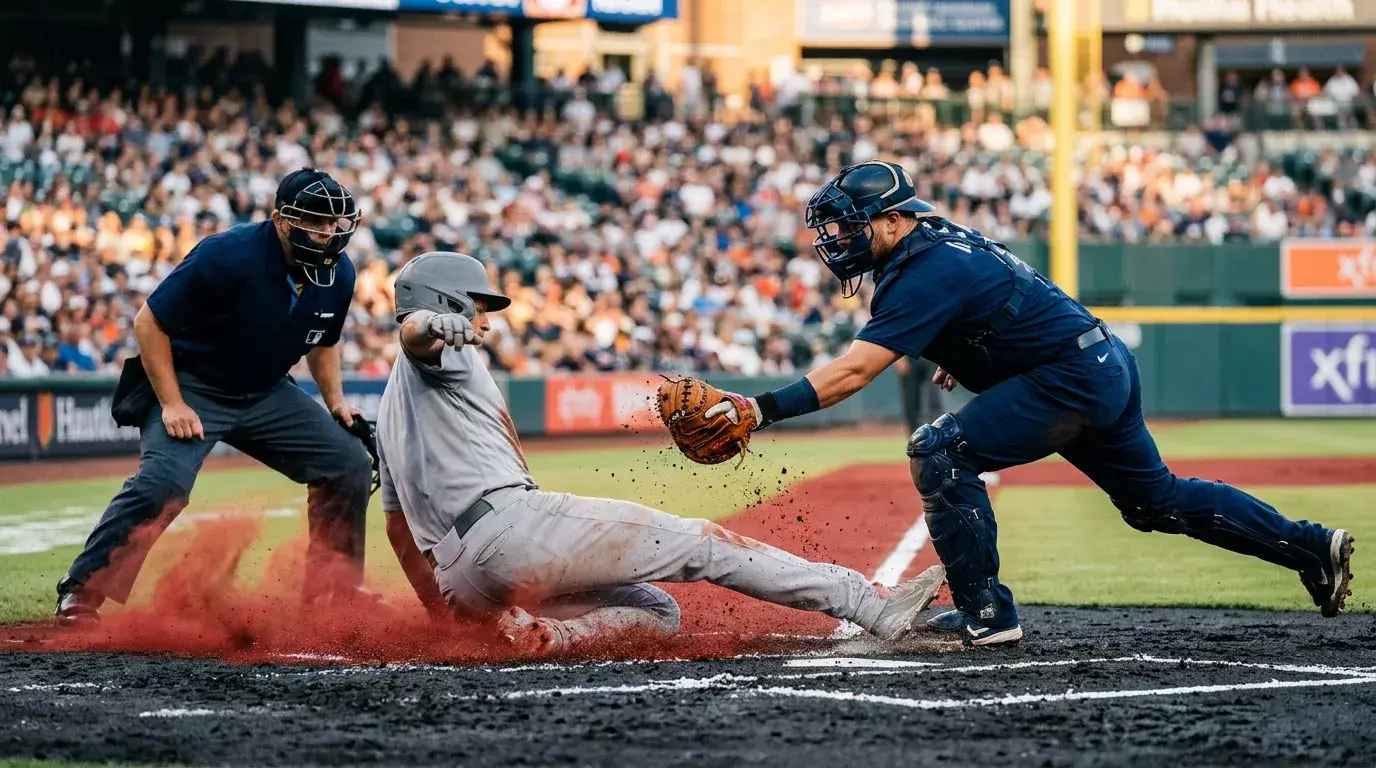
Mechanically: back the favourite at −1.5 and your team must win by two or more. Back the underdog at +1.5 and you win if they win outright or lose by exactly one run. Prices flip compared to the moneyline. A 1.50 moneyline favourite might be 2.10 on the run line; the 2.70 underdog shortens to roughly 1.74, because the 1.5-run cushion catches a huge chunk of close games.
How the prices actually flip
Imagine a typical matchup. Moneyline: Dodgers 1.50, Reds 2.70. Same teams on the run line: Dodgers −1.5 at 2.10, Reds +1.5 at 1.74. A £10 stake on the Dodgers moneyline returns £15. The same stake on Dodgers −1.5 returns £21 — but only if they win by two or more. £10 on Reds +1.5 returns £17.40 if they win or lose by exactly one run.
The run line is functionally identical to an Asian handicap at −1.5 / +1.5. If you have ever backed Manchester City at AH −1.5 in the Premier League, you have already placed a run line bet without knowing it. The mechanics are the same; only the sport changes.
A push on 1.5 is arithmetically impossible — the margin cannot be exactly 1.5 in a sport that scores in whole numbers. Sportsbooks offer alternate lines at −2.5, −3.5, +2.5 and so on for punters who want a different margin point, but the standard 1.5 is what tops every MLB matchup page.
The run line earns its place on the underdog side. Backing a 1.50-priced favourite outright requires a 67 per cent strike rate just to break even. Backing the same team at +1.5 at 1.74 only needs 57.5 per cent. That is a more forgiving threshold for an underdog whose moneyline price you cannot stomach, and many sharp MLB bettors live there.
TAKEAWAY — The run line is fixed at 1.5 because nearly three in ten MLB games end by one run. Backing the favourite at −1.5 gets you a longer price in exchange for needing a two-run win; backing the underdog at +1.5 gets you a cushion in exchange for a shorter price.
The complete worked-through value analysis — when the favourite at −1.5 is genuinely the sharper play, when the underdog at +1.5 is mispriced, how the typical price flip between moneyline and run line should look, and how the line compares to football's Asian handicap — sits in the MLB run line betting explained deep dive.
Totals: Reading the Game's Run Environment
If you have ever bet over 2.5 goals in a Premier League fixture, the MLB total is the same idea with a different number. It grabs less attention than the moneyline and run line, but it is where the matchup intelligence actually lives — what the market thinks about both starters, both bullpens, the weather and the ballpark, all packaged into one number.

A typical MLB total sits between 7 and 10 runs, often 8.5 or 9. You bet over or under that number; the combined score at the end of the game settles your wager. If the line is 8.5 and the final is 6–4, the over wins. If the final is 3–2, the under wins. The price on each side is usually close to decimal 1.91 — the standard −110 vig — though a book may shade one side to 1.83 or stretch the other to 2.00 when heavy money piles up.
A standard MLB total at a glance
Total: 8.5 runs. Over 8.5 at decimal 1.91. Under 8.5 at decimal 1.91. Implied probability of each side ≈ 52.4 per cent, with the 4.8 per cent overlap covering the sportsbook's margin.
What pushes the number up? A worn-out bullpen, two underperforming starters, a humid summer night in Cincinnati, a tailwind at Wrigley, a series at Coors. What pulls it down? Two aces facing each other, cold April conditions, a marine layer over San Francisco, two strong bullpens in a pitcher's park. The line is the market's combined verdict on all of it.
Average regular-season MLB game time was 2 hours 38 minutes in 2025, the third consecutive year under 2:40 after three decades of longer matches. Shorter games mean fewer plate appearances and less bullpen damage. The market knows — totals lines have nudged downward in tandem with the pace-of-play reforms.
One distinction worth pinning down: the full-game total covers nine innings plus extras. The First Five Innings total — F5 — settles at the end of the fifth and removes most bullpen exposure. The F5 line is usually around half the full-game total, but the price relationship is not a simple division because relievers tend to give up runs at a higher rate than starters do in the early innings.
Live totals are where the market gets interesting. Every half-inning re-prices the over and under based on score, inning and the incoming pitcher. If a starting ace has thrown seven shutout innings and the score is 2–0, the over on a 9-run total has drifted from 1.91 pre-match to perhaps 4.50 by the seventh-inning stretch.
The full breakdown of how totals lines are set, the factors that push them up and down, and the strategy of comparing F5 against full-game totals sits in the MLB totals and over/under betting deep dive.
Props, Parlays and Same-Game Multis
A reader once messaged me to ask why the strikeout prop on his favourite pitcher had a £200 limit when the moneyline next to it would happily take £2,000. He thought it was a glitch. It was not. It was a deliberate policy change that reshaped the entire MLB micro-betting landscape in late 2025, and it tells you something important about the asymmetric risks props carry compared to the main markets.
Props — short for proposition bets, sometimes called specials on UK slips — are wagers on a specific occurrence within a game rather than its outcome. Will a particular pitcher record over 6.5 strikeouts? Will a specific batter hit a home run? Will the first run be scored in the first inning? The available props on a single MLB game can run to several hundred lines across batter performance, pitcher performance, team outcomes, and timing markets like NRFI and YRFI.
The three main prop categories at a glance
| Category | Typical examples | Why bettors use them |
|---|---|---|
| Batter props | Anytime home run, total bases over/under, hits over 1.5, RBIs over 0.5 | Isolate a specific player without taking a position on the game outcome |
| Pitcher props | Strikeouts over/under, outs recorded, earned runs under 2.5 | Pure pitcher analysis without the variance of run support |
| Game-level props | NRFI/YRFI, total team hits, race to 5 runs | Granular angles a moneyline cannot express |
The vig on props is meaningfully higher than on the main markets. Where a moneyline runs at around 4 to 5 per cent margin, a typical strikeout prop carries 8 to 12 per cent. Single-pitch markets have historically carried wider margins still.
Parlays — accumulators in the British vernacular — combine two or more bets into a single slip. Every leg must win, and the prices multiply, producing the long-shot returns that fund social media screenshots. Same-game multis let you combine bets from a single game, with one critical wrinkle: the legs are correlated, and the sportsbook builds a correlation adjustment into the price. That adjustment almost always favours the book.
I treat parlays the way I treat dessert. I enjoy them. I do not pretend they are a balanced diet. The vig compounds across legs, and a four-leg parlay where each leg is fairly priced still walks into a sportsbook margin north of 20 per cent on the overall slip.
The 2025 integrity reset capped single-pitch bets and excluded them from parlays — the case behind that move is covered in the integrity section below. The full picture of prop pricing, how same-game multis handle correlation, and a realistic view of prop profitability sits in the MLB player props and parlays guide.
Futures: World Series, Division and Award Markets
My favourite kind of bet is the one I get to think about for six months. Futures — known as outrights or antepost in the UK — are wagers on season-long outcomes placed well in advance of resolution. Who will win the World Series? Which team takes the AL East? Who wins American League MVP? These are positions you take in March and discover the answer to in October.
The World Series outright is the headline market. Hal Egeland, trading manager at BetMGM, captured the shape of the early 2026 market well: he was not surprised to see the Dodgers leading in both tickets and handle — back-to-back champions who were already a very public team, and that kind of off-season would increase handle on any team, let alone the Dodgers. That is the futures market in one sentence: driven as much by narrative, public attention and recency as by underlying projection.
What makes futures different from a single-game bet
Your money is locked up. A typical World Series future placed in March settles in late October or early November. Liquidity in the market improves through the season as more information arrives — trade deadline, injuries, win streaks — but the price you took in March is the price you keep, unless the operator offers cash-out. Antepost rules vary: most UK books pay out if your team makes the postseason and wins; some void if the season is shortened or restructured.
The 2025 World Series between the Dodgers and Blue Jays drew at least 25 million viewers for Game 7 in the United States, with a series average above 14 million. MLB topped the YouGov SportsIndex brand health rankings for the year at 26.9 — a 39 per cent improvement on its 2022 figure. The futures market is being priced into a sport whose audience is growing, and deeper markets mean tighter prices.
Award futures behave differently from team futures. MVP and Cy Young markets move on narrative as much as on numbers. A pitcher who throws a no-hitter on a Tuesday in June can see his Cy Young price halve overnight, regardless of whether the no-hitter actually changed his underlying season projection. Smart bettors look for moments where narrative compresses the price beyond what the underlying data justifies.
Division futures sit in the middle. Less coverage than the World Series, more grounded than awards, and often the sharpest place to take a position because the six MLB divisions price quite differently. A favourite in a weak division can be priced at 1.60 to win their division while sitting at 8.00 to win the World Series, and the gap reveals what the market thinks of their playoff floor.
The complete strategy for picking your moment — and the antepost rules that determine whether your bet stands when seasons get strange — lives in the World Series futures betting deep dive.
The Listed Pitcher Rule and Why Your Bet Might Get Voided
The single most common reason a UK punter messages me angry on a Saturday afternoon is that their MLB bet got voided. They had backed the Yankees moneyline. The Yankees won. The bet did not pay. What happened? The starting pitcher changed. That is the listed-pitcher rule in action, and it catches more first-time MLB bettors than any other operator quirk.
By default, most UK sportsbooks treat MLB moneyline and run line wagers as "listed pitchers" — the bet is conditional on both announced starting pitchers actually starting. If either listed starter is pulled before the first pitch, the bet is voided and your stake returned. The fact that your team won the game becomes irrelevant. You bet on a matchup that did not happen.
The alternative is an "action" bet. You specify at the slip-building stage that your wager stands regardless of who pitches. The price may shift slightly because the operator is now exposed to whatever scratch happens, but the bet will not void on a pitcher change. Most UK books let you set this per bet or as an account-wide default. The catch is that many bettors never look at the toggle.
Late scratches happen more often than you would think. A bullpen session goes badly, an off-day flu lingers, a manager pivots to a bullpen game for matchup reasons. In a 162-game season, several per cent of all scheduled starts get changed in the final hours. If you placed a listed-pitcher bet in the morning and the news drops at 4pm Eastern, your slip is heading for the refund queue.
✓ Do
- Check whether your bet is listed or action before submitting.
- Re-check the starting pitcher announcement within an hour of first pitch.
- Use action bets if you are taking a strong view on a team regardless of pitcher.
- Treat refunded stakes as neutral in your bankroll tracking.
✗ Don't
- Assume your sportsbook default matches another book's default — they vary.
- Build a parlay where one leg is listed-pitcher unless you are happy for it to void.
- Treat a refunded bet as a sign you "would have won" — you did not bet on the actual game.
- Place same-game multis without reading the operator's pitcher-change rules.
Props complicate the picture. A strikeout prop on a pitcher who does not start usually voids cleanly. A batter prop on a player left off the lineup card normally voids, though some operators specify "must play at least one plate appearance" instead. Same-game multis can void some legs and keep others, with the slip recalculating on the surviving legs. Settlement logic varies meaningfully between major UK-licensed books.
The rule to internalise is simple: if you do not specify, your bet is probably listed, and a pitcher change probably voids it.
The Maths Behind the Price: Vig, Hold and Break-Even
Every sportsbook wants you to focus on the win price and ignore the structure underneath it. Every bettor who lasts more than a season learns to do the opposite. The price on your screen is the fair price minus the operator's margin — variously called vig, juice, hold or overround.
The break-even arithmetic is the place to start. At a standard −110 price (decimal 1.91), you need to win 52.4 per cent of your bets just to break even. Win at 53 per cent and you barely cover the juice. Win at 55 per cent and you are producing meaningful long-run profit. Most professional MLB bettors target a 53 to 55 per cent win rate on −110 markets and treat anything higher as suspicious.
Why 52.4 per cent matters
At decimal 1.91, the implied probability is 1 ÷ 1.91 = 52.4 per cent. To break even, you need to win at that rate. Above it, you profit. Below it, you lose.
The reason both sides of a totals market are priced at 1.91 — even though the true probabilities are 50/50 — is that 52.4 per cent + 52.4 per cent = 104.8 per cent. The 4.8 per cent excess is the operator's margin on that market. That is the vig.
Now compare market types. A standard −110/−110 line carries roughly 4.5 per cent theoretical hold. A dime line — where one side is −110 and the other is +100 — carries about 2.3 per cent. Across a long season, that difference compounds: 10,000 units at 4.5 per cent expected vig bleeds 450 to the house; the same volume on a 2.3 per cent market bleeds 230.
Margin across MLB markets at a glance
| Market type | Typical pricing | Theoretical hold |
|---|---|---|
| Standard moneyline / run line / totals | −110 / −110 | ~4.5% |
| Dime line moneyline | −110 / +100 | ~2.3% |
| Player strikeout prop | Asymmetric pricing | ~8–12% |
| Same-game multi (4 legs) | Multiplied + correlation | ~15–25% |
The 2025 average national hold on US sportsbooks landed at 10.15 per cent — operators kept about $10.15 of every $100 bet across all markets. That blended figure includes high-margin parlay and prop business. MLB-specific hold is lower for sharps who stick to moneylines and run lines, higher for casual bettors whose slips are heavy with props and accumulators.
The lesson is layered. The price you take matters at least as much as the pick: a 53 per cent winner at −110 makes money, while a 60 per cent winner at −150 (break-even 60.0 per cent) makes nothing. Sticking to lower-margin markets gives you more room for error. Internalise 52.4 per cent, internalise 4.5 per cent, and the rest will follow.
Trust, Integrity and What Recent MLB Scandals Mean for Bettors
There is a moment in any conversation about baseball betting integrity where the person across the table from me leans forward and asks, somewhat nervously, whether the games are fixed. The full games are not. The micro-bets — granular markets on what happens on the very next pitch — turned out to be vulnerable in ways the industry did not fully anticipate, and the response has reshaped what UK punters see on their slips in 2026.

The story broke open in October 2025 when a federal indictment alleged that Cleveland Guardians pitcher Emmanuel Clase and his associates had won approximately $27,000 on a single rigged pitch in May 2023 and $96,000 across two games in June 2023, through prop bets timed to specific pitch outcomes. A separate case in June 2024 had already seen MLB ban Tucupita Marcano for life for placing 387 bets on baseball totalling over $150,000, with four other players receiving year-long suspensions. The pattern was clear: threats were not coming from team-level fixing but from individuals exploiting the easiest, most predictable kind of granular outcome.
The November 2025 reset
Leading American sportsbooks introduced a nationwide $200 cap on bets on individual pitches and excluded those bets from parlay construction. The rationale was straightforward — limit the maximum payout on the easiest market to manipulate, and remove the parlay multiplier that turned a small rigged outcome into a six-figure haul. UK-licensed operators have moved in parallel, narrowing or removing single-pitch markets entirely on most consumer-facing slips.
Commissioner Rob Manfred has been measured but direct. Before Game 2 of the 2025 World Series, he said the league's number one priority was to protect the integrity of the game, and that MLB had great systems in place to do it. At the November 2025 owners' meetings he was more specific: the most important undertaking and the bedrock of the relationship with sportsbooks was the ability to monitor betting activity, and the ability to discern inappropriate patterns was really, really important. That is the data-sharing infrastructure that did not exist a decade ago.
From the US Senate Commerce Committee letter to Commissioner Manfred in November 2025: an isolated incident of game rigging might be dismissed as an aberration, but the emergence of manipulation across multiple leagues suggests a deeper, systemic vulnerability. That is the political pressure behind the operational changes. Both sides — league and sportsbook — moved because Washington was watching.
For a UK punter the practical effects are concrete. Single-pitch markets are largely gone or capped. Some prop markets carry tighter operator limits. Live betting suspends more aggressively when unusual line movement triggers an alert. None of this affects the moneyline, run line, totals or most batter and pitcher props. The integrity infrastructure is significantly stronger in 2026 than it was twelve months ago.
Responsible Gambling: UK-Specific Help and Habits
I have a friend who quit betting at thirty-one after realising he had been chasing losses for the better part of two years without ever quite admitting it to himself. He was the smartest gambler I knew. Nothing about being good at the maths protects you from the psychology, and pretending otherwise is how clever people walk into trouble. This section is short, but it is the most important part of the guide.

The British numbers give a baseline. Roughly 48 per cent of UK adults took part in some form of gambling activity in the four weeks preceding the latest Gambling Survey for Great Britain wave (excluding lotteries, that drops to 27 per cent). Of those who gambled in the last year, 7.3 per cent reported experiencing at least one signal of harm on the Problem Gambling Severity Index — small as a percentage, significant in absolute terms.
The UK support landscape
Three names belong on every UK punter's mental shortlist. GamCare runs the National Gambling Helpline, available 24 hours a day. GAMSTOP is the free self-exclusion service that lets you block yourself from every UK-licensed online operator simultaneously for six months, one year, or five years. BeGambleAware funds independent advice and the Annual GB Treatment and Support Survey that informs how the entire sector talks about harm.
Operational habits matter more than helpline numbers most of the time. Setting a deposit limit before your first MLB season pitch is the single most useful action you can take with your account. Most UK-licensed books prompt you to set one during sign-up because the data is very clear that bettors who use deposit limits experience materially less harm than bettors who do not. You cannot chase a bigger loss than you have access to fund.
A monthly self-check for any MLB bettor
- Has betting started to interrupt sleep, work or relationships?
- Am I betting on games I would not bother watching otherwise?
- Have I deposited more this month than I planned at the start?
- Am I chasing a specific loss with a stake size larger than I would normally place?
- Do I feel relief from betting rather than enjoyment of it?
If you answer yes to two or more, treat that as a signal worth acting on. The point is not to quit — it is to step back, set firmer limits, and re-evaluate.
The pillar message is brief: gamble with money you can afford to lose, use the limit tools your operator must offer, and reach out to GamCare, GAMSTOP or BeGambleAware before a difficult month turns into a difficult year.
What to Run Through Before Your First MLB Slip
I keep a paper copy of the following list on my desk, and I run through it the first time I place an MLB bet of each new season. It is not glamorous, but it has saved me from more avoidable mistakes than any sharp model I have ever built. Slowing down for ninety seconds before submitting a slip is the cheapest edge available in this sport.
Run through this before you click confirm
- Have both starting pitchers been confirmed, and have I checked their status within the last hour?
- Am I reading the price in decimal — or about to misread an American line?
- Is my bet "listed" or "action", and does that match what I intended?
- What does the implied probability actually say about this outcome, and do I genuinely believe the true probability is higher?
- What is the weather forecast for first pitch, and does it affect a totals or props position?
- Is the operator UK-licensed by the Gambling Commission?
- Have I set a deposit limit, and is this stake within the unit size I committed to?
- If I lose this bet, will I feel fine about it tomorrow morning? If not, the stake is too large.
Eight questions. Ninety seconds. Run them once at the start of every betting week, and again on any bet larger than your standard unit, and you will avoid the three or four most common ways MLB betting goes sideways. None of it is about being smarter than the market — it is about being slightly more disciplined than the impulse to click.
Frequently Asked Questions
How does baseball betting work for UK punters?
It works through the same UK-licensed sportsbooks you use for Premier League football, in decimal odds, under the same consumer-protection rules. The four main markets are the moneyline (winning team), the run line (a fixed 1.5-run spread), totals (over/under on combined runs), and a wide selection of player and game props. Futures cover season-long outcomes. The major operational quirk is the listed-pitcher rule: if either announced starter fails to start, your moneyline or run line bet usually voids unless you chose an "action" bet.
What is the difference between the moneyline and the run line?
The moneyline asks who wins outright. The run line adds a fixed 1.5-run spread: win on the favourite at −1.5 and your team must win by two or more; win on the underdog at +1.5 and your team must win outright or lose by exactly one. Because nearly 30 per cent of MLB games end on a one-run margin, prices flip sharply — a 1.50 moneyline favourite might stretch to 2.10 on the run line. You trade certainty for price in either direction.
Why is the run line in baseball always 1.5?
Because the single most common winning margin in baseball is one run — roughly 28 to 30 per cent of all MLB games end that way. The 1.5 line sits half a run above that, splitting the market cleanly into "favourite wins comfortably" and "underdog wins outright or loses narrowly". A 1.0 line would create constant pushes; a 2.5 line would be too cushioned. Books offer alternate run lines at 2.5 or 3.5, but 1.5 remains the structural standard.
What happens to my bet if the listed starting pitcher is changed?
At most UK-licensed sportsbooks, the default is that the bet voids and your stake is returned, regardless of whether your team won. The listed-pitcher rule treats your wager as conditional on both announced starters actually starting. The exception is if you explicitly chose an "action" bet, which stays live regardless. Props on the affected pitcher normally void cleanly. Batter props on hitters left off the lineup typically also void, though some books grade by "must record at least one plate appearance".
How do I convert American odds to decimal odds used in the UK?
For a positive price like +130: divide by 100, add 1 — so 130 ÷ 100 = 1.30, plus 1 = 2.30. For a negative price like −150: divide 100 by the absolute value, add 1 — so 100 ÷ 150 = 0.6667, plus 1 = 1.67. Implied probability from any decimal is 1 ÷ decimal. Most UK books default to decimal with a one-click toggle, so manual conversion is mostly useful for reading American sources.
Is betting on MLB legal for UK residents?
Yes, provided you place your bet with a sportsbook holding a remote betting licence from the UK Gambling Commission. MLB is a foreign league, but every market on a UK-licensed slip falls under the same Gambling Act 2005 framework that governs Premier League betting. You must be 18 or over and complete identity verification before your first withdrawal. Unlicensed offshore sites offer none of the dispute-resolution routes or consumer protections that the UK-licensed market provides.
Do I pay tax on baseball betting winnings in the UK?
No. Personal gambling winnings in the United Kingdom are not taxable, and you do not declare them on a self-assessment return. The tax is paid by the operator: General Betting Duty receipts in the first quarter of 2025/26 came to £188 million, around 6 per cent higher than the same period the previous year — that is the levy your sportsbook pays to HMRC on its profits. From your perspective as a punter, you keep what you win.
Related posts
Unit Sizing & MLB Bankroll Management UK

Algorithmic Projections & MLB Handicapping Models UK