Price Conversion for American Odds to Decimal
 Available in US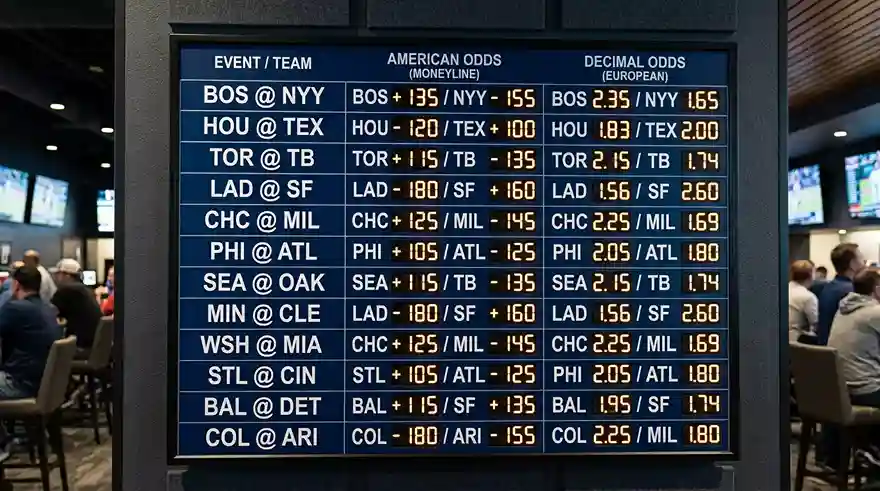
Conversion is a two-line piece of arithmetic. The structure of the formula is identical for every price; only the sign matters. Once you have it embedded, you can do most MLB prices in your head within a couple of seconds.
Plus-Money Mathematical Conversions for UK Punters
Plus-money prices are the easier of the two formats to convert. The formula is straightforward: take the American number, divide by 100, then add 1. The result is the decimal price.
+130 in American. Divide 130 by 100 to get 1.30. Add 1. Decimal price is 2.30. That is the price displayed on a UK slip for the same bet.
+200 converts to 3.00. +150 converts to 2.50. +180 converts to 2.80. +110 converts to 2.10. The pattern is consistent because plus-money is already expressed in terms of profit on a 100 stake – adding 1 simply includes the stake itself in the return, which is what decimal odds represent.
The mental shortcut for round-number plus prices is to think of the leading two or three digits as a percentage of the stake, then add the stake back. +250 means 250 per cent profit, total return 350 per cent of stake – decimal 3.50. +500 means 500 per cent profit, total return 600 per cent – decimal 6.00. This way of thinking is faster than the formal arithmetic once you do it a few times.
Where plus-money conversion catches people is on awkward numbers like +135 or +165. Those convert to 2.35 and 2.65 respectively. Most UK operators round to two decimal places, which means the conversion is exact at this granularity. The rounding does not cost you anything meaningful on a single bet.
Minus-Money Conversion: A Slightly Different Step
Minus-money prices require flipping the formula. Take 100, divide by the absolute value of the American number, then add 1.
-150 in American. Absolute value is 150. Divide 100 by 150 to get 0.667. Add 1. Decimal price is 1.667, which rounds to 1.67 on most UK slips.
-110 converts to 1.91. -200 converts to 1.50. -125 converts to 1.80. -130 converts to 1.77. The mechanic is the same every time – flip the fraction.
The mental shortcut for round minus numbers is to think about how much profit you make on a 100 stake. At -200, you risk 200 to win 100, so a 100 stake wins 50. Decimal 1.50. At -150, you risk 150 to win 100, so a 100 stake wins 67. Decimal 1.67. Working backwards from the implied profit ratio is sometimes faster than the formal division, especially on round-number favourites.
The trickiest minus prices are the ones close to -110 where books cluster their juice. -108, -112, -115 are all very common on totals and run lines. They convert to 1.93, 1.89 and 1.87 respectively. The differences are small but they matter when you are comparing prices across multiple books for the same market – those couple of points of decimal price compound across a season of regular betting.
Implied Probability: The Third Number to Read
Once you can convert between formats, the next step is reading implied probability. This is the number that tells you what percentage chance the book is pricing for the outcome, after accounting for their margin.
The decimal formula is clean: implied probability equals 1 divided by the decimal price. A price of 2.00 gives 50 per cent. A price of 1.50 gives 67 per cent. A price of 4.00 gives 25 per cent. A price of 1.91 – the standard -110 – gives 52.4 per cent.
The 52.4 per cent is the number every serious bettor should commit to memory. It is the break-even rate at the standard juice. To make money long term on -110 markets, you need to win more than 52.4 per cent of your bets. Hit 53 per cent and you are profitable. Hit 54 per cent and you are doing very well. Hit 55 per cent and you are running better than almost any professional bettor over a long sample.
Implied probability also tells you where the book’s margin sits. On a balanced market with -110 on both sides, the implied probabilities sum to 104.8 per cent. The 4.8 percentage point overage is the theoretical hold – the bit the book takes regardless of who wins, on average. Some markets like the dime line on baseball moneylines run at lower hold, around 2.3 per cent. Props and parlays run higher, sometimes 6 to 8 per cent on a balanced book.
For UK punters, knowing the implied probability is the bridge between American-sourced analysis and decimal-priced bets. An American analyst saying “this team should be a 55 per cent favourite” tells you the fair decimal price is around 1.82 – which lets you check whether your UK book’s 1.83 or 1.85 represents value. The deeper application of implied probability is in calculating no-vig fair prices, which the article on MLB vig and juice covers in full.
Common MLB Prices in Both Formats
Building familiarity is mostly about repetition. Here are the MLB prices you will see most often, side by side, until they become automatic.
Moneyline favourites typically range from -110 to -250 in American, which is decimal 1.91 to 1.40. -120 is 1.83. -130 is 1.77. -140 is 1.71. -150 is 1.67. -160 is 1.63. -180 is 1.56. -200 is 1.50. -250 is 1.40.
Moneyline underdogs typically range from +100 to +220. +100 is decimal 2.00 – a true even-money bet. +110 is 2.10. +120 is 2.20. +130 is 2.30. +140 is 2.40. +150 is 2.50. +180 is 2.80. +200 is 3.00. +220 is 3.20.
Standard -110 juice on totals and run lines converts to decimal 1.91 on both sides. You see this number on virtually every standard MLB market. Knowing it instantly saves you time.
Heavy-favourite props occasionally drop below decimal 1.40. Anytime home run prices for top hitters in friendly parks land around +280 to +400, which is 3.80 to 5.00. Strikeout overs on ace pitchers at -130 to -140 sit at 1.77 to 1.71. These ranges are the meat of MLB pricing – most of your bets will sit in here.
Conversion Questions
The two questions I get asked most about conversion are about specific common prices and about whether the rounding to two decimal places costs you anything meaningful over time. Both have clean numerical answers.
What is the quickest mental shortcut to convert -110 odds on the move?
Memorise the conversion: -110 equals 1.91 in decimal. That single price comes up so often on totals and run lines that it is worth burning into memory rather than calculating every time. The implied probability is 52.4 per cent – the break-even rate at standard juice. Once you know -110 equals 1.91, you can approximate prices near it on the fly: -105 is roughly 1.95, -115 is roughly 1.87, -120 is roughly 1.83.
Does rounding decimal odds cost money over many bets?
No, at typical UK operator granularity. Books round decimal prices to two places, which means the worst-case rounding loss on any single bet is half of one per cent of expected return. Over a thousand bets that adds up to small numbers – under one per cent of total turnover lost to rounding alone. The real cost of poor conversion is making the wrong bet entirely because you misread the price, not the rounding.
This material was created by the Mound & Margin team.
Related posts
Unit Sizing & MLB Bankroll Management UK

Algorithmic Projections & MLB Handicapping Models UK