Anytime HR Odds & MLB Home Run Props Betting
 Available in US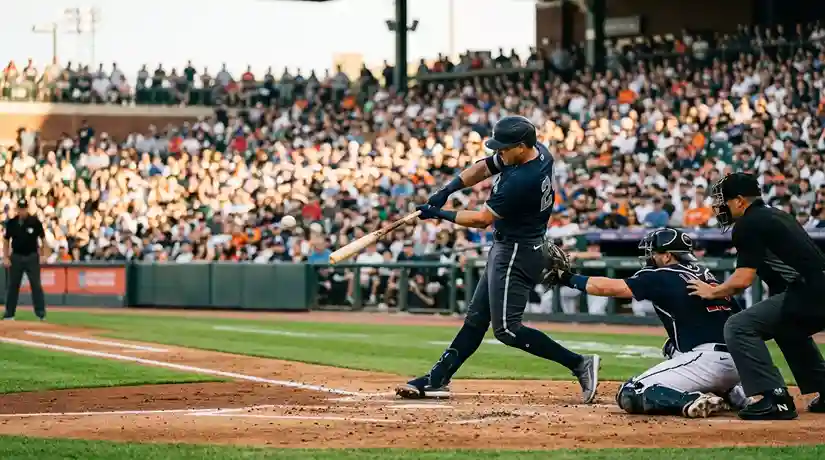
Understanding home run prop markets is partly about the pricing structure, partly about the inputs the book uses to set the number, and partly about resisting the gravitational pull of the player-name effect. The Mookie Betts anytime HR at decimal 4.50 feels different from the Lenyn Sosa anytime HR at decimal 4.50 even when the implied probability is identical. Both are the same bet from a maths perspective. The book is selling you the name as much as the outcome.
Pricing the Anytime Home Run Prop Market
Anytime home run is the headline prop in the MLB market. You pick a batter, you stake a number, and you win if that batter hits at least one home run during the game. Multiple home runs do not pay more on the standard market – one is enough.
Typical anytime HR prices range from about decimal 3.50 for the heaviest power hitters in friendly parks down to decimal 12 or longer for light-hitting middle infielders. The implied probability range is therefore roughly 28 per cent at the top end to 8 per cent at the bottom. Most regulars sit between 15 and 22 per cent implied – corresponding to decimal prices between 4.50 and 6.50.
The hold on this market is significant. If you sum the implied probabilities of every batter listed for both teams in a given game, the total typically lands around 110 to 115 per cent. That is 10 to 15 per cent hold across the market – three to four times the moneyline’s standard juice. The book is making it back on the margin because the variance on individual home run outcomes is high, and they need cushion to absorb spike events.
For UK punters, the anytime HR market is where small stakes become entertaining without doing serious damage when they miss. Backing two or three anytime HR props at a fiver each on a slate is reasonable bankroll management. The same stake on a multi-leg HR parlay is where bankrolls disappear – the hold compounds across legs and the combined probability shrinks faster than the price grows.
First and Last Home Run Markets
Beyond anytime, books offer first home run and last home run markets, which sit at much longer prices and behave very differently.
First home run scorer asks you to pick the batter who hits the first home run of the game. The prices stretch dramatically – even premier power hitters typically price at decimal 10 to 14 in this market, because the chance of being the first specifically is far smaller than the chance of being the only or one-of-several. Multiple home runs in a game are common, and only the first counts.
The implied probability on first HR for a top-tier slugger is around 7 to 9 per cent. Compare that to their anytime HR at 22 per cent – the gap is the chance of homering after someone else has already homered. Most home runs do not score first in their game; many come in the middle innings or late.
Last home run scorer follows the same pattern but with even longer prices, because being the last requires nobody else to homer afterwards. The prices on last HR for top sluggers typically run decimal 14 to 18. This market sees less volume than first HR and the prices are correspondingly less efficient – meaning there is occasionally value, but also that the variance is brutal.
Neither market should be a regular play. They are entertainment products, designed for the punter who wants to back a specific player at a long price and accept the long-odds outcome.
What Goes Into a Home Run Prop Price
The book’s pricing engine for HR props combines several inputs. Knowing them helps you sense-check whether a specific price is fair, generous or expensive.
Isolated power – slugging percentage minus batting average – is the headline input. A batter with .250 ISO is a clear power threat. A batter with .150 ISO is middle of the pack. A batter with .090 ISO is a contact hitter with occasional pop. The ISO directly drives the baseline probability of a home run on any given at-bat.
Fly ball rate matters next. A batter has to put the ball in the air to homer. Hitters with 40 per cent fly ball rates produce more HR opportunities than 25 per cent ground ball merchants, even at similar ISO levels. Recent flyball rate is a meaningful adjustment to the baseline.
The opposing pitcher’s HR rate allowed is the third major input. A starter who gives up 1.4 HR per 9 innings is a different opponent than one who gives up 0.7. The book adjusts the HR prop line by the matchup-specific HR rate, which can shift the implied probability by 3 to 5 percentage points.
Ballpark factor is the fourth, and it can be massive. Coors Field, Great American Ball Park and the short porches at Yankee Stadium all inflate HR rates by 10 to 20 per cent compared with league average. Pitcher-friendly parks with deep dimensions and heavy air – Oracle Park, Petco Park, T-Mobile Park – suppress HR rates by similar magnitudes. The article on park factor and MLB betting covers this in detail and is essential reading before you back HR props systematically.
Weather is the fifth input. Wind direction and temperature both affect ball carry. A 12 mph wind blowing out at Wrigley adds meaningfully to HR probability. Cold conditions reduce it. The book bakes weather into the line within hours of the forecast updating.
What is not usually a major input: lineup spot. Top-of-order hitters get more at-bats than bottom-of-order ones, but the difference is one extra plate appearance per game on average. The HR prop is not heavily sensitive to lineup position.
How UK Books List Home Run Specials
UK operators have expanded their HR prop offerings significantly over the past three seasons, partly tracking the US market’s growth and partly responding to MLB’s brand health gains – the league’s brand health score hit 26.9 in 2025, the top spot among measured leagues by 39 per cent over its 2022 figure. That growth has translated into more market depth on UK-facing books.
The standard anytime HR market is now available on most UK operators offering MLB. Lineup-based pricing – where the prop is offered only after the lineups are confirmed – is becoming the default. Some operators still offer pre-lineup pricing with explicit refunds if the player is not in the lineup; others void the bet by default if the player does not start.
Same-game multi structures including HR props are common. You can combine an anytime HR with a moneyline or a totals line and the book will price the correlation between the legs. The correlation is real – a team that hits a home run is more likely to win the game and more likely to push the total – and the book prices it accordingly. The resulting multi price is shorter than the naive multiplication would suggest, by sometimes 10 to 15 per cent.
Specials around major events have grown. World Series HR markets, postseason MVP-related HR props and longer-term HR leader markets are increasingly listed during the season. These are entertainment markets with wide juice – the book is selling engagement, not value – but they are part of the menu UK punters now have access to.
Home Run Prop Questions
Two questions UK bettors ask most about HR props concern the lineup card rules and why the prices look so similar across most batters in the heart of a lineup. Both reflect how books actually structure these markets.
Are home run props void if the player is left off the lineup card?
At most UK operators yes, but the rules vary. Books that require lineup confirmation before pricing the prop typically void the bet and refund the stake if the player is unexpectedly out of the starting lineup. Books that price pre-lineup may instead pay out at the original price if the player makes any plate appearance during the game – pinch-hitting counts as participation for settlement. Check the specific operator’s prop bet rules before staking on a player whose start is uncertain.
Why are anytime home run prices similar across most batters?
Because the base rate of hitting a home run in a single MLB game is fairly compressed for everyday lineup hitters. Most regulars run between 12 and 22 per cent probability of going deep on any given day. That translates to decimal prices between 4.50 and 8.50 for the bulk of starters. The extremes – top-tier power hitters at decimal 3.50 to 4.00, and weak-hitting middle infielders at 10.00 or longer – are where the pricing differentiates. The middle 80 per cent of the market clusters tightly.
This material was created by the Mound & Margin team.
Related posts
Unit Sizing & MLB Bankroll Management UK

Algorithmic Projections & MLB Handicapping Models UK