10-Cent Margins & MLB Dime Line Markets
 Available in US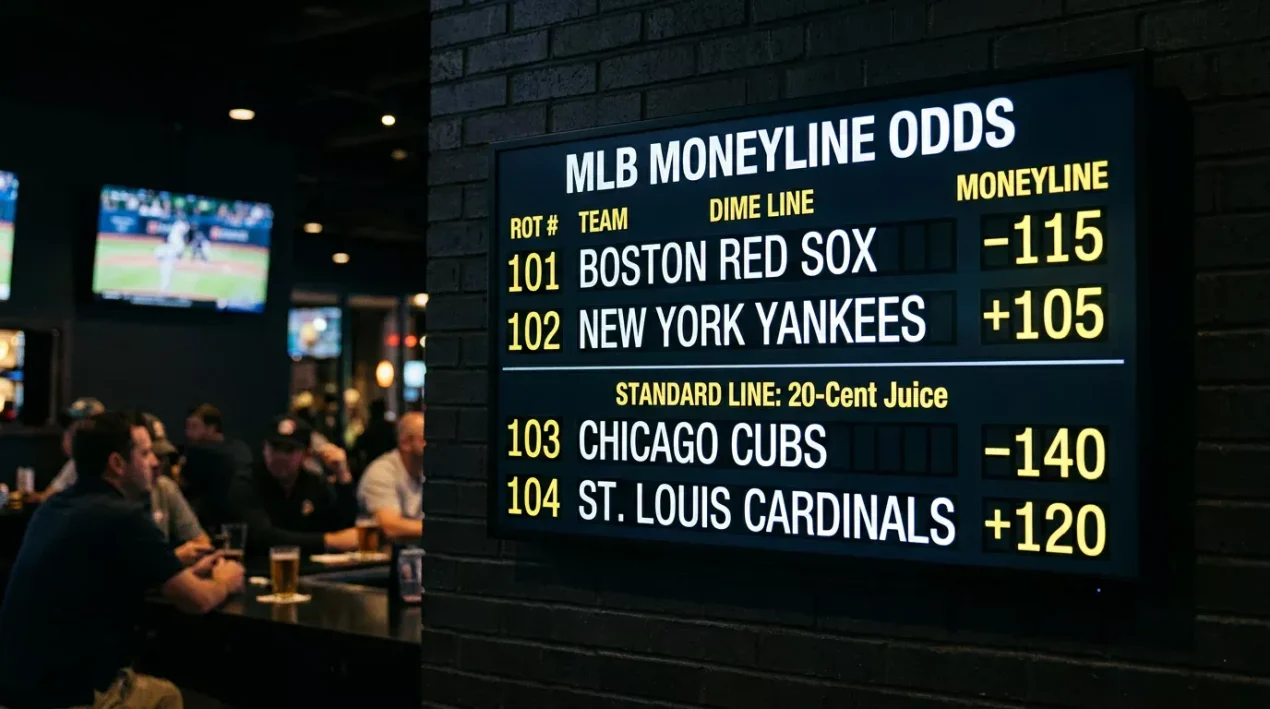
The dime line is a tighter margin moneyline market, mostly seen in baseball, where the gap between the favourite price and the underdog price is exactly ten cents in American odds. The mechanic is mathematical, the appeal is commercial, and the implication for UK bettors is worth understanding even if you cannot always access it.
The Evolution of the 10-Cent MLB Dime Line
Baseball moneylines have historically been priced differently from other major American sports because there is no point spread. In NFL or NBA, the book uses a spread to balance the moneyline at -110 on both sides regardless of how lopsided the teams are. Baseball does not have a primary spread market – the run line is fixed at 1.5 and behaves differently – so the moneyline has to do the heavy lifting.
To accommodate uneven matchups, baseball moneylines stretch. A favourite of -150 on one side typically pairs with an underdog of +130 on the other. The gap between -150 and +130 is twenty cents in American odds, which is why the standard baseball moneyline is sometimes called a twenty-cent line.
The dime line compresses this to ten cents. The same matchup that prices at -150 / +130 on a twenty-cent line would price at -150 / +140 on a dime line. The favourite remains the same, but the underdog gets a longer price. That longer price means lower implied hold for the book and better value for the bettor on the underdog side. Conversely, in some configurations the favourite price improves by five cents and the underdog price improves by five cents – both sides get a slight upgrade.
The dime line originated in the more competitive parts of the US sports betting market, particularly in offshore and high-volume domestic books that wanted to attract professional bettors. The maths reduces hold significantly, which means the book is making less per bet but expects to make it up in volume. Not every book offers it, and most retail-focused operations stick with the twenty-cent default.
How a 10-Cent Line Changes the Maths
The hold reduction on a dime line versus a twenty-cent line is the headline number, and it is meaningful.
Standard baseball moneyline at -150 / +130: implied probabilities are 60 per cent and 43.5 per cent, summing to 103.5 per cent. Hold is 3.5 per cent.
Dime line at -150 / +140: implied probabilities are 60 per cent and 41.7 per cent, summing to 101.7 per cent. Hold is 1.7 per cent.
The hold has nearly halved. For a bettor who plays moneylines consistently, this is a substantial improvement. Over a season of regular betting, paying 1.7 per cent hold instead of 3.5 per cent means roughly half the long-term grind against the book. Whether that turns a losing strategy into a winning one depends on the strategy, but it absolutely shifts the maths in the bettor’s favour.
On heavier favourites the effect is sometimes even more pronounced. A -200 / +175 twenty-cent line carries a hold close to 3.8 per cent. The dime equivalent of -200 / +185 drops the hold below two per cent. The bigger the favourite, the more the dime line compression matters for both sides.
What stays the same: the favourite implied probability is unchanged. The book is not saying the favourite is more or less likely to win. They are just charging less margin on the underdog side. From a bettor’s perspective, the dime line is essentially the book trading some of its expected profit for the bettor’s expected loss. That trade only works for the book if the volume compensates, which is why dime lines tend to appear on books that genuinely chase sharp money.
Finding Dime Lines With UK-Facing Books
The honest answer for UK punters is that finding a true dime line on UK-licensed operators is harder than finding it on the historical US market. Most UK books default to the twenty-cent baseball line and stick with it.
What you can do is line-shop across multiple UK operators and find spots where one book has compressed its margin closer to dime territory even without calling it that. The gap between a favourite price and an underdog price varies operator by operator, and the spread sometimes narrows on high-profile MLB games where books compete for handle.
The closer the gap between the favourite and the underdog approaches ten cents, the closer you are to a dime line in practice. A moneyline of -150 / +135 has a fifteen-cent gap – half-dime, sometimes called by punters. That is between a twenty-cent line and a dime line, and it still represents a meaningful improvement on the hold. Always worth checking when you find one.
The other route to dime-equivalent pricing is the exchange-style operators, where peer-to-peer pricing can drift very close to no-vig levels minus the exchange’s commission. The mechanics are different – you are matching against another bettor rather than the book – but the effective price on the underdog side often resembles what a dime line offers, particularly on liquid markets. The deeper context on how vig works across markets, and why the dime line is a particularly clean reduction of it, sits in the article on MLB vig and juice.
Dime Line vs 20-Cent Line: Compounding the Edge Over a Season
The reason dime lines matter is not the single bet – it is the season. Across a typical year of MLB betting at regular volume, the difference between dime and twenty-cent pricing compounds into real money.
Consider a punter who bets a hundred pounds on moneylines fifty times a month from April through September. That is 300 bets, 30,000 pounds of turnover. At standard 3.5 per cent hold, the expected loss is roughly 1,050 pounds across the season, assuming no edge over the market. At dime-line 1.7 per cent hold, the expected loss is roughly 510 pounds. The difference – 540 pounds – is the cost of the wider margin compounded over volume.
For bettors who think they have a small genuine edge over the market, the dime line is even more important. If your true edge is two per cent above market – a respectable real edge – then standard twenty-cent pricing eats most of it. Dime-line pricing leaves the entire edge intact. The same bettor who is a marginal loser on twenty-cent pricing becomes a clear winner on dime-line pricing, purely because of how much margin the book extracts on each bet.
This is why professional MLB bettors hunt dime lines obsessively. Not because they are exotic, and not because they unlock different markets – they are the same bets at lower cost. Lower cost compounded across a 162-game schedule is the difference between a hobby and a sustainable position.
For casual UK punters who play a few games a week, the absolute difference is smaller but the principle is identical. Always take the longer underdog price when the favourite price is the same across two books. That is the dime-line logic applied to whatever menu the UK market offers.
Dime Line Questions
The two questions UK punters ask most about the dime line are about whether it exists on UK-licensed operators and whether it actually guarantees you will make money. Both have honest answers that sit somewhere between yes and no.
Is a dime line common on UK sportsbooks?
No, the strict dime line is rare on UK-licensed operators. Most UK books default to a twenty-cent baseball line as the standard moneyline pricing convention, and they advertise it as the same product without naming it. You can occasionally find dime-equivalent prices when you line-shop across operators or use exchange-style products where peer-to-peer matching pushes margins close to no-vig levels. True dime-line pricing is mostly an American sportsbook feature.
Does a dime line guarantee value, or just smaller margin?
It guarantees smaller margin, not value. A dime line means the book is charging you less hold on each bet, which compounds into real savings over volume – but it does not change whether you are picking the right side. If you back losers on a dime line, you still lose. The dime line shifts the maths in the bettor’s favour by the difference in hold, typically around 1.5 to 2 percentage points. That is meaningful but it does not turn bad bets into good ones.
This material was created by the Mound & Margin team.
Related posts
Unit Sizing & MLB Bankroll Management UK

Algorithmic Projections & MLB Handicapping Models UK